


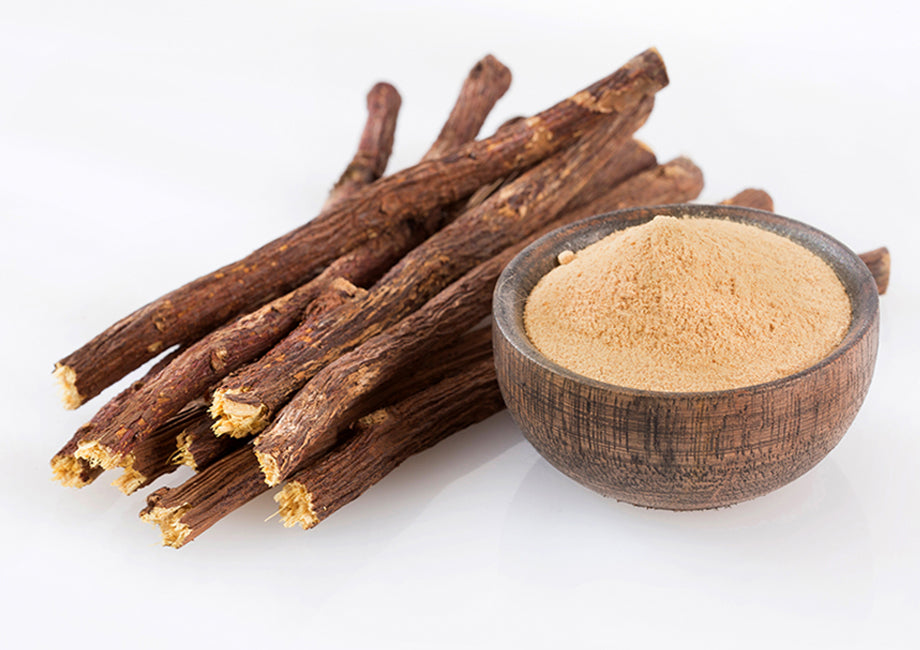
Open an old Pahadi kitchen tin and you'll often find a few pale, fibrous roots tucked next to the cardamom. That's mulethi, chewed on for a scratchy throat long before anyone thought to call it an adaptogen. In the Indian subcontinent it's known as mulethi. Botanically, it's the root of Glycyrrhiza glabra, better known in English as licorice.
It's one of the more studied herbs in Ayurvedic and Chinese medicine, and for good reason. But it's also one of the easier herbs to overdo, because its main active compound behaves a little like a hormone once it's in your system. So this guide tries to do something most mulethi articles skip: separate what's actually been tested from what's just old, comforting habit, and be honest about where the safety line sits.
Key takeaways
-
Mulethi's sweetness, and most of what's been studied about it, comes down to glycyrrhizin, a compound roughly 50 times sweeter than sugar.
-
The best-supported uses are for digestive discomfort, sore throat, and a few skin and oral conditions. The evidence ranges from small human trials to lab studies, so it's worth knowing which is which.
-
Drinking a lot of it regularly can raise blood pressure and lower blood potassium. Most health bodies suggest keeping glycyrrhizin intake to around 100 mg a day.
-
If you're pregnant or breastfeeding, or you have high blood pressure, heart disease or kidney disease, it's best to avoid regular mulethi use unless your doctor says otherwise.
-
This article is written to inform, not to replace a conversation with your doctor.
What is mulethi, exactly?
Mulethi is a perennial shrub in the pea family. It's native to the Mediterranean, West Asia and parts of India, and it grows best in dry, sunny spots with deep, well-drained soil. The root is harvested, dried and then used whole, powdered or as an extract, in tea, kadha, candies and Ayurvedic formulations.
Its defining compound, glycyrrhizin, is what gives mulethi its intense natural sweetness, and it's also behind most of the biological activity researchers have looked at. Anti-inflammatory, antimicrobial and antioxidant effects have all been studied in lab and clinical settings.
In Ayurveda, mulethi is classified as sita (cooling) and madhura (sweet), and has traditionally been used to soothe the throat, ease digestion and support general vitality.
What the evidence actually says
Sore throat, cough and mild respiratory discomfort
This is mulethi's oldest, most consistent use. Chewing the root or gargling with a mulethi infusion is a genuine household remedy across North India, the kind your grandmother probably reached for before you did. Clinical research on gargling with licorice before surgery has shown it can reduce throat irritation afterward, and lab studies point to real anti-inflammatory activity in the airway lining. Evidence for treating something like asthma is still mostly limited to animal studies, so it's fairer to call this a comfort measure than a treatment.
Digestive discomfort and stomach lining support
This is where mulethi actually has some of its stronger human evidence. Deglycyrrhizinated licorice, or DGL (more on that below), has been studied for functional dyspepsia and general gastric discomfort, and licorice extract has been trialled alongside standard care for H. pylori-related ulcers with encouraging results. It's reasonable to say mulethi may support digestive comfort. It isn't a substitute for diagnosing or treating an ulcer.
Skin conditions
Compounds in mulethi, particularly glabridin, inhibit the enzyme that triggers melanin production. That's why it shows up in skin-brightening formulations for pigmentation and melasma. A small clinical study also found a licorice-containing cream worked about as well as a mild hydrocortisone cream for eczema symptoms. These are useful, topical, small-study findings, not a claim that mulethi treats a skin disease.
Oral health
A thorough 2023 review in the journal Healthcare found licorice compounds show real anti-adhesive and antimicrobial activity against the bacteria behind plaque, cavities and gum inflammation, and several small trials support licorice-based mouth rinses for reducing plaque and soothing mouth ulcers. This is genuinely one of the better-evidenced uses, even if most of the trials are still small.
Immunity, weight, hormones and liver health
You'll see mulethi described online as an immunity booster, a fat burner and a fertility aid. Take that with a pinch of salt. Most of it comes from animal or lab studies, or from traditional Ayurvedic reasoning rather than clinical evidence. Early research suggests glycyrrhizin has liver-protective and antiviral properties worth exploring further, and there are some human trials looking at body composition, but none of this adds up to a “boosts immunity” or “aids fertility” claim. Ayurvedic texts do describe mulethi as rasayana, or rejuvenating, and good for strength. That's a traditional description worth respecting on its own terms, not something to dress up as clinical proof.
How mulethi is traditionally used
Mulethi shows up in a few familiar forms across Indian households.
As tea or kadha, the dried root is simmered in water, often with ginger or tulsi, for throat and digestive comfort. As churna, or powder, it's mixed into warm water or milk before meals. As a gargle, the powder is dissolved in warm water for a sore throat or bad breath. Some people simply chew the root, a traditional remedy for cough and mild acidity, and it's sometimes used topically too, mixed into pastes with honey or rose water.
If you want mulethi's sweetness and comfort without the full glycyrrhizin load, look for DGL, deglycyrrhizinated licorice, a processed form with the compound largely removed. It's commonly used for digestive support and carries a lower systemic risk profile.
How much is safe
There's no single official daily dose for whole mulethi, but public-health bodies have set guidance around its active compound. The World Health Organization and the European Scientific Committee on Food both point to roughly 100 mg of glycyrrhizin a day as a reasonable ceiling for regular consumption. For context, a single cup of mulethi tea made with a teaspoon of root generally sits well under that. Licorice candies, concentrated extracts and one cup too many can add up faster than you'd expect. The U.S. FDA classifies licorice as generally recognized as safe in food when used appropriately.
An occasional cup of mulethi tea for a sore throat is a very different thing from taking concentrated mulethi supplements every day for weeks. The safety profile changes with dose and duration, not with the plant itself.
Who should be careful with mulethi
Regular or high-dose glycyrrhizin can push cortisol-related hormones up, which makes the body hold on to sodium and lose potassium. In sensitive people, or with sustained use, this has been linked to high blood pressure, an irregular heartbeat, swelling and, in rare, extreme cases, more serious complications.
It's worth being especially careful, and talking to a doctor before regular use, if you're pregnant or breastfeeding (licorice has been linked to a higher risk of preterm birth in high-consumption studies), if you have high blood pressure, heart disease or kidney disease, if your potassium levels already run low or you're on medication like diuretics that lower them further, or if you're taking blood pressure medication, blood thinners such as warfarin, corticosteroids or hormonal contraceptives, since mulethi can interact with all of these. The same caution applies to giving it to young children, especially in candy form, where the actual glycyrrhizin content is rarely labelled clearly.
If you're otherwise healthy and enjoy mulethi now and then as tea or kadha, none of this is cause for alarm. It's a reason for moderation, not avoidance.
Bringing mulethi into your everyday cup
Mulethi has long been a natural companion to Himalayan herbal blends. Its sweetness means you often need little or no added sugar, and it pairs easily with tulsi, ginger or green tea. If you're exploring herbal or immunity-focused teas, it's worth checking The Pahadi Story's herbal tea range for blends rooted in traditional Himalayan ingredients. Just check the ingredient list if you're managing blood pressure or are pregnant.
Note for internal review: please confirm whether a current TPS SKU actually contains mulethi before this line goes live. We didn't find one in the current catalogue and don't want to imply a product claim that isn't accurate.
Frequently asked questions
Is mulethi the same as licorice candy?
No. Licorice candy is often flavoured with anise and loaded with added sugar, and the amount of real glycyrrhizin in it varies widely and is rarely disclosed. That's part of why candy-related overdose cases show up in medical literature.
Can I drink mulethi tea every day?
An occasional cup is unlikely to cause problems for most healthy adults. It's daily, long-term use, especially several cups a day, where the glycyrrhizin-related risks like raised blood pressure and low potassium become more relevant.
Is mulethi safe during pregnancy?
Current guidance leans toward avoiding regular mulethi consumption during pregnancy, since higher intake has been linked to preterm birth risk in research. Speak with your doctor before using it.
What is DGL and why would I choose it?
DGL is licorice with most of the glycyrrhizin removed. It's used for digestive comfort without the blood pressure and potassium concerns of regular licorice, though it's a different product with different, and less studied, effects than whole mulethi.
Does mulethi whiten skin?
Compounds in mulethi can reduce melanin production, which is why it appears in some pigmentation-focused skincare. “Whitening” claims should still be treated cautiously, and any topical use is worth patch-testing first.
Sources & references
1. AlDehlawi H, Jazzar A. “The Power of Licorice (Radix glycyrrhizae) to Improve Oral Health: A Comprehensive Review of Its Pharmacological Properties and Clinical Implications.” Healthcare (Basel). 2023;11(21):2887.
2. Wahab S, et al. “Glycyrrhiza glabra (Licorice): A Comprehensive Review on Its Phytochemistry, Biological Activities, Clinical Evidence and Toxicology.” Plants. 2021;10(12):2751.
3. The Ayurvedic Pharmacopoeia of India, Part 1, Volume 1; classical properties of Yashtimadhu (mulethi).
4. U.S. National Center for Complementary and Integrative Health (NCCIH), Licorice Root fact sheet.
Note:-
This article is for general educational purposes and does not replace personalised advice from a qualified healthcare professional. If you are pregnant, nursing, or managing a health condition, speak with your doctor before using mulethi regularly.