


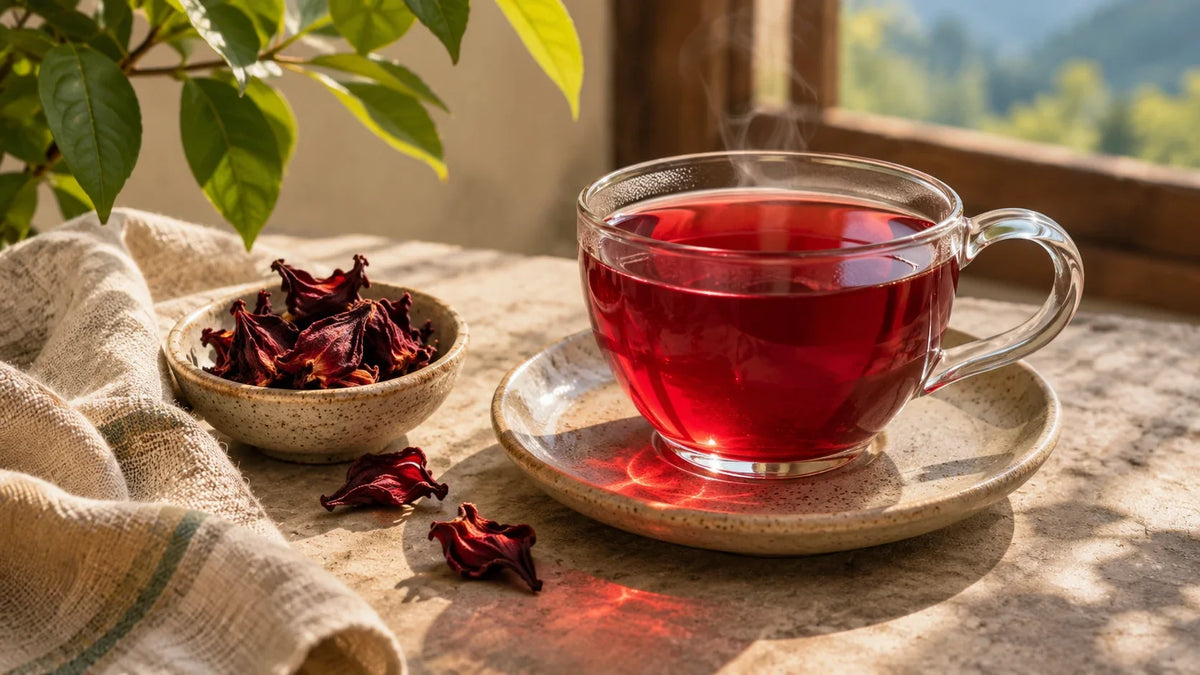
That deep red cup of hibiscus tea is more than a pretty drink. It's one of the few herbal teas with real human trials behind it, mostly for blood pressure. It's also tart, caffeine-free and easy to make at home, hot in winter or iced in summer.
But a lot of what you read online mixes up facts. Some posts call it a weight loss drink. Some say it's packed with vitamin C. Some don't even agree on which hibiscus goes in the cup. This guide sorts it out: what hibiscus tea actually does, how much to drink, who should skip it, and three simple ways to brew it.
Hibiscus tea is a caffeine-free herbal tea made from the dried red calyces of the roselle plant (Hibiscus sabdariffa). Its best-supported benefit is a modest drop in blood pressure in people with mildly high readings. Evidence for cholesterol, blood sugar and liver health is promising but mixed, and the weight loss effect is very small. Most healthy adults can drink 1 to 3 cups a day. Skip it if you're pregnant, and check with your doctor if you take BP, diabetes or malaria medicines.
What is hibiscus tea?
Hibiscus tea is made by steeping the dried calyces of the roselle plant in hot or cold water. The calyx is the fleshy red cup that holds the flower. It gives a ruby-red brew with a sour, cranberry-like taste. That's why it's also called "sour tea" in many countries.
Around the world it goes by many names: karkade in Egypt and Sudan, bissap in West Africa, zobo in Nigeria, and agua de Jamaica in Mexico. In India, roselle is the same plant whose leaves are cooked as gongura in Andhra and pulicha keerai in Tamil Nadu.
Roselle vs gudhal: which hibiscus is in your cup?
This is where most Indian articles get confused. There are two hibiscus plants people make tea from:
|
Roselle (Hibiscus sabdariffa) |
Gudhal / shoe flower (Hibiscus rosa-sinensis) |
|
|---|---|---|
|
Part used |
Dried red calyces |
Petals of the red garden flower |
|
Taste |
Strongly tart, fruity |
Mild, slightly earthy |
|
Colour of tea |
Deep ruby red |
Pink to purple |
|
Research on it |
Dozens of human trials |
Mostly lab and animal studies |
|
Common use in India |
Tea, sherbet, gongura |
Temple offerings, hair oils, home remedies |
Almost all the human studies on blood pressure and cholesterol used roselle. So when you see a benefit in this guide, it's about roselle tea. The Pahadi Story's Hibiscus Tea is 100% dried roselle calyces, with nothing added.
If you like floral brews, you might also enjoy our guide to floral tea benefits.
Hibiscus tea nutrition
A cup of brewed hibiscus tea is almost all water. According to USDA data quoted by Dr. Axe, an 8 oz (about 240 ml) cup has:
- Calories: 0 (unsweetened)
- Caffeine: 0 mg
- Manganese: about 1.1 mg, close to half your daily need
- Potassium, calcium, magnesium, iron: small amounts
- Vitamin C: close to 0 mg once brewed
That last point surprises people. Dried roselle does contain vitamin C, but very little ends up in the tea. Don't drink it as a vitamin C source. Have amla, guava or lemon for that.
The real value is in the plant compounds. Hibiscus is rich in anthocyanins (the pigments that make it red), other polyphenols and organic acids. These are what the research links to its effects on blood pressure and blood fats.
Hibiscus tea benefits, ranked by evidence
Here's an honest look at what the research shows. "Strong" means several human trials agree. "Mixed" means some trials show a benefit and others don't. "Early" means mostly lab or animal work.
|
Benefit |
What studies found |
Evidence |
|---|---|---|
|
Lower blood pressure |
3 cups a day for 6 weeks cut systolic BP by 7.2 points vs 1.3 on placebo |
Strong (modest effect) |
|
Lower LDL cholesterol |
Pooled trials in people with metabolic syndrome: LDL down about 7 to 9 mg/dL; other trials found no change |
Mixed |
|
Steadier blood sugar |
Pooled trials: fasting sugar down about 3.7 mg/dL |
Mixed (small effect) |
|
Liver health |
450 mg extract daily lowered liver enzymes in adults with fatty liver |
Early to mixed |
|
Weight loss |
Across 6 trials, weight changed by about 0.27 kg |
Weak |
|
Antioxidant, anti-inflammatory |
High in anthocyanins and polyphenols; lab studies show antioxidant activity |
Early |
1. It may lower blood pressure
This is the benefit with the most proof. In a well-known Tufts University trial, 65 adults with slightly high blood pressure drank 3 cups of hibiscus tea a day for 6 weeks. Their systolic pressure (the top number) dropped by 7.2 points, compared with 1.3 points in the placebo group, as summarised by Dr. Axe.
Pooled reviews of many trials find systolic drops of roughly 4.7 to 7.6 points. A 2022 review of clinical trials lists more than 20 studies where hibiscus tea, extract or capsules lowered blood pressure, usually in trials lasting 2 to 6 weeks.
Two things to keep in mind. First, RxList rates it only "possibly effective" because the trials are small and use different doses. Second, it's a support, not a replacement. Never stop or cut your BP medicine because you started drinking hibiscus tea.
2. It may help with cholesterol
Some trials show hibiscus lowering total cholesterol, LDL and triglycerides, especially in people with diabetes or metabolic syndrome. In one study in people with type 2 diabetes, 2 cups a day for a month lowered LDL by 8% and triglycerides by about 15%, and raised HDL by about 17% (PMC review).
But other trials found no change in LDL at all. So it's a nice extra for heart health, not a cholesterol treatment.
3. It may support steadier blood sugar
Hibiscus compounds slow down enzymes that break down starch, which may soften sugar spikes after meals. In one trial, adults with type 2 diabetes who took 500 mg capsules twice a day for 8 weeks saw fasting sugar fall from 143 to 119 mg/dL (PMC review). Pooled results for plain tea are much smaller, around 3 to 4 mg/dL.
If you're diabetic, the bigger point is safety: hibiscus can add to the effect of diabetes medicines. More on that below.
4. It may be good for the liver
In two small trials, a 450 mg hibiscus extract taken daily lowered liver enzymes in adults with fatty liver (8 weeks) and reduced liver fat in adults with obesity (12 weeks). Note that these used concentrated extracts, not tea. And at very high doses, animal studies saw liver enzymes go up, as Medical News Today points out. Normal cups of tea are a different thing, but more isn't better.
5. Weight loss: smaller than you'd think
Hibiscus tea won't melt belly fat. In a 12-week trial, people taking 450 mg of extract daily lost about 1.2 kg (PMC review). Across 6 trials, the average change was about a quarter of a kilo.
Where it really helps is as a swap. A glass of unsweetened iced hibiscus instead of a cola or packaged juice saves you 100 to 150 calories, every time.
6. It's full of antioxidants
The anthocyanins that give hibiscus its colour are strong antioxidants in lab tests. They're the same family of compounds you find in jamun, blueberries and red grapes. That's a good reason to enjoy it, even if the human evidence for "fighting free radicals" is still early.
How much hibiscus tea should you drink a day?
For most healthy adults, 1 to 3 cups a day is a sensible amount. That lines up with the trials, which mostly used 2 to 3 cups, each made with about 1.25 to 2 g of dried calyces (Dr. Axe). Medanta also puts the safe daily range at 1 to 3 cups, and warns that 4 to 5 cups or more can cause acidity.
In simple kitchen terms: 1 heaped teaspoon of dried hibiscus (about 2 g) per 200 to 240 ml cup.
How to make hibiscus tea at home
You need just dried hibiscus and water. Here are three ways to make it, one for each season.
1. Classic hot hibiscus tea (5 to 7 minutes)
- Boil 240 ml of water.
- Add 1 heaped teaspoon (about 2 g) of dried hibiscus to a cup or teapot.
- Pour the hot water over it and cover.
- Steep for 5 to 7 minutes. Longer makes it more sour.
- Strain. Add a little honey or a slice of lemon if you like.
Add honey once the tea has cooled a little, not into boiling water.
2. Cold brew hibiscus (best for summer)
- Add 2 heaped teaspoons of dried hibiscus to 500 ml of room-temperature water in a glass bottle.
- Refrigerate for 6 to 8 hours or overnight.
- Strain and serve over ice with a few mint leaves and a squeeze of lime.
Cold brewing gives a smoother, less sour taste. A pinch of black salt and roasted jeera turns it into a desi summer cooler.
3. Winter hibiscus with ginger and cinnamon
Hibiscus is seen as a cooling drink, so in winter warm it up with spices.
- Simmer 300 ml of water with 3 to 4 thin slices of ginger and a small piece of cinnamon for 3 minutes.
- Turn off the heat and add 1 heaped teaspoon of dried hibiscus.
- Cover and steep for 5 minutes, then strain.
- Sweeten with a little jaggery or honey.
Can you add milk to hibiscus tea?
It's best not to. Hibiscus is very acidic, so it splits milk the same way lemon does. Drink it plain, or with honey, lemon or spices.
Can you mix chamomile and hibiscus tea?
Yes. Both are caffeine-free and they blend well. Chamomile softens the sourness of hibiscus and adds a light, honey-like taste. Use about half a teaspoon of each per cup and steep for 5 minutes. It makes a nice evening cup.
Best time to drink hibiscus tea
-
Between meals: Hibiscus polyphenols can reduce how much iron you absorb from food. If you're low on iron, drink it 1 hour before or after meals (Medanta).
-
Not on an empty stomach if you get acidity: Its natural acids can upset a sensitive stomach. Have it after a light snack.
-
Evening is fine: With zero caffeine, it won't keep you up.
Hibiscus tea vs green tea vs chamomile
|
Hibiscus tea |
Green tea |
Chamomile tea |
|
|---|---|---|---|
|
Caffeine |
None |
25 to 40 mg per cup |
None |
|
Taste |
Tart, fruity |
Grassy, slightly bitter |
Mild, floral, honey-like |
|
Best known for |
Blood pressure support |
Antioxidants (EGCG), alertness |
Relaxation and sleep |
|
Good at night? |
Yes |
Not ideal |
Yes |
|
Hot or cold |
Both work well |
Mostly hot |
Mostly hot |
Want to compare more teas? Read our guide on chai vs green tea.
Hibiscus tea side effects
Hibiscus tea is safe for most people in normal amounts. RxList rates it "likely safe" in food amounts. When side effects do show up, they're usually mild:
- Acidity or upset stomach, especially on an empty stomach or with more than 4 cups a day
- Gas or loose motions in some people
- Feeling light-headed if your blood pressure is already low
- Tooth enamel wear from frequent sipping of any sour drink. Rinse your mouth with water after, or use a straw for iced hibiscus.
- Allergy, which is rare. Stop if you notice itching or swelling.
- Who should avoid hibiscus tea
|
Who |
Why |
What to do |
|---|---|---|
|
Pregnant women |
Hibiscus may bring on periods, which could raise the risk of miscarriage (RxList) |
Avoid |
|
Breastfeeding mothers |
Not enough safety data |
Avoid to be safe |
|
People with low BP |
It can lower blood pressure further |
Avoid or check with your doctor |
|
People on BP medicines (amlodipine, telmisartan, losartan, diuretics) |
It can add to the medicine's effect |
Ask your doctor first and check your readings |
|
People on diabetes medicines (metformin, glimepiride, insulin) |
It may lower blood sugar further |
Ask your doctor first and check your sugar |
|
People taking chloroquine |
Hibiscus sharply reduces how much of the drug your body absorbs, a "major" interaction |
Avoid |
|
Anyone with surgery coming up |
It can affect sugar control |
Stop at least 2 weeks before |
|
People with kidney stones |
Contains oxalates |
Keep to 1 cup and ask your doctor |
|
People with low iron |
Can reduce iron absorption |
Drink between meals |
|
People with acidity, gastritis or ulcers |
It's naturally acidic |
Have it after food, or skip it |
Hibiscus may also interact with paracetamol, some cholesterol medicines and hormonal birth control, according to Medical News Today and Dr. Axe. If you take any regular medicine, a quick word with your doctor is the safe move.
How to pick good dried hibiscus
-
Colour: Deep red to burgundy. Dull brown means old stock.
-
Shape: Whole or broken calyces, not fine dust. Dust brews muddy and bitter.
-
Smell: Fresh and fruity-sour. A musty smell means moisture got in.
-
Ingredients: Only hibiscus. No added colour, flavour or sugar.
-
Storage: Airtight jar, away from sunlight. Use within 6 to 12 months for the best taste.
Our Hibiscus Tea ticks every box: 100% dried roselle calyces, no preservatives and lab tested.
The bottom line
Hibiscus tea is a tasty, caffeine-free drink with real research behind it, mostly for gentle blood pressure support. It may also help a little with cholesterol and blood sugar, but it's not a weight loss shortcut or a medicine. Keep to 1 to 3 cups a day, drink it between meals, and skip it if you're pregnant or on BP, diabetes or malaria medicines without your doctor's okay.
Ready to try it? Brew a cup of our 100% natural Hibiscus Tea, or explore our full range of herbal teas.
This article is for general information and isn't medical advice. Talk to your doctor before using hibiscus tea if you have a health condition or take regular medicine.
Hibiscus tea FAQs
Is it okay to drink hibiscus tea every day?
Yes, for most healthy adults. 1 to 3 cups a day is a safe range. More than 4 to 5 cups can cause acidity and may reduce iron absorption.
Does hibiscus tea have caffeine?
No. Pure hibiscus tea is naturally caffeine-free, so you can drink it in the evening without it affecting your sleep.
Can hibiscus tea reduce belly fat?
Not by itself. Trials show only a very small effect on weight. It helps most when it replaces sugary drinks like cola or packaged juice.
Is gudhal tea the same as hibiscus tea?
No. Hibiscus tea is usually made from roselle (Hibiscus sabdariffa) calyces. Gudhal is the garden shoe flower (Hibiscus rosa-sinensis). Most human research on blood pressure and cholesterol used roselle.
Can I drink hibiscus tea during pregnancy?
It's best to avoid it. Hibiscus may bring on periods, which could raise the risk of miscarriage. There's also too little safety data for breastfeeding.
I take BP medicine. Can I drink hibiscus tea?
Check with your doctor first. Hibiscus can lower blood pressure, so it may add to your medicine's effect. Never cut or stop your medicine on your own.
Can I drink hibiscus tea in winter?
Yes. Have it warm and add ginger and cinnamon to balance its cooling nature. It's a nice caffeine-free swap for your second cup of chai.
Can you mix chamomile and hibiscus tea?
Yes. They're both caffeine-free and blend well. Chamomile softens the sour taste of hibiscus, which makes it a good evening drink.