


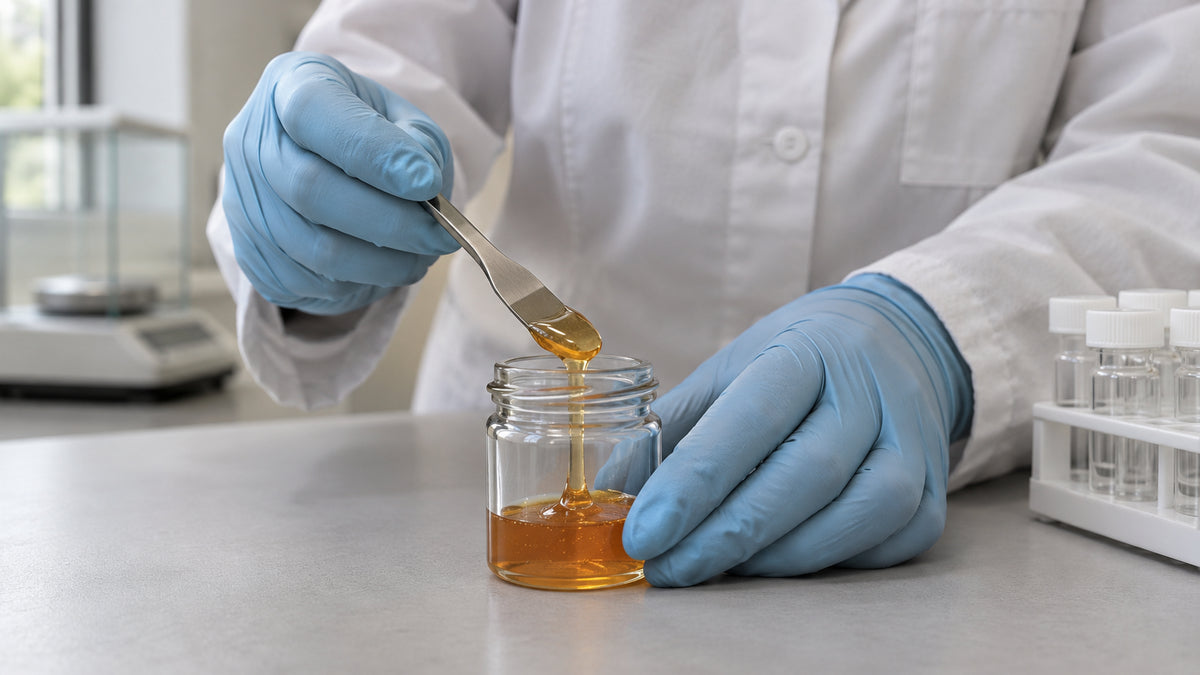
You've probably seen the videos. Drop honey in water, light a matchstick, put a drop on your thumb. If it passes, it's pure. Simple, right?
Not quite. Some of these tests can catch cheap, watered-down honey. But the fake honey sold in India today is made to pass them. This guide walks you through every popular home test, tells you honestly what each one can and can't catch, and shows you what actually proves honey is pure.
Home tests like the water, thumb and paper tests can spot honey with added water or very crude syrups. They can't detect the rice and sugar syrups that are now used to fake honey, because those syrups are designed to look and behave like real honey. The only real proof is a lab test. So use home tests as a first filter, then buy from brands that tell you where their honey comes from and how it's tested.
Why you should care: how common fake honey is in India
In December 2020, the Centre for Science and Environment (CSE) tested 13 popular and smaller honey brands sold in India. According to CSE's investigation, 77% of the samples failed an advanced lab test called NMR, and only 3 brands passed every test.
The scary part? Most of the failed samples had passed India's standard tests at the time. CSE found that sugar syrups were being "designed" to get past those checks. If lab tests struggled to catch them, a glass of water at home won't either.
9 home honey tests, rated honestly
Here's every test you'll see online, what it claims, and what it really tells you.
|
Test |
How to do it |
What it really tells you |
Reliable? |
|---|---|---|---|
|
Water test |
Drop a spoon of honey into a glass of room-temperature water |
Thick honey sinks in a lump. Catches watered-down honey, but modern syrups sink too |
Partly |
|
Thumb test |
Put a drop on your thumb |
Shows thickness, not purity. Thick syrups pass easily |
Low |
|
Paper test |
Drop honey on tissue or blotting paper |
A wet ring means extra water. Can't catch syrups with low moisture |
Partly |
|
Flame test |
Dip a matchstick tip in honey and strike it |
Checks water content only. Real forest honey from humid months can fail |
Low |
|
Vinegar test |
Mix honey, water and a few drops of vinegar |
Foam means chalk-type fillers, which are rarely used now |
Low |
|
Bread test |
Spread honey on bread and wait |
Soggy bread means extra water. Says nothing about syrups |
Partly |
|
Crystallisation |
Watch if honey turns grainy over time or in the cold |
Raw honey often crystallises. But some real honeys stay runny for years |
Partly |
|
Heat test |
Heat honey in a pan |
Kills honey's natural enzymes. Don't do this |
Avoid |
|
Ant test |
See if ants come to the honey |
No scientific basis |
No |
How to do the water test properly
If you're going to do one test, make it this one. It takes a minute.
- Fill a clear glass with water at room temperature.
- Take 1 teaspoon of honey and let it drop in gently. Don't stir.
- Watch for 10 to 20 seconds.
- Real honey sinks and sits at the bottom as a lump or thick thread. Honey with added water starts spreading and clouding the water straight away.
- Now stir. Real honey still takes a while to dissolve.
A pass doesn't prove the honey is pure. A fail is a strong sign something's wrong.
Why home tests can't catch modern fake honey
Old-style fake honey was easy to spot: sugar water, jaggery syrup or honey cut with water. Home tests were built for that.
Today's adulterants are different. They're syrups made from rice, corn or sugar cane, processed to match honey's thickness, sugar mix and moisture. As Royal Bee Brothers points out, these syrups sit at the bottom of a glass and hold their shape on your thumb just like real honey.
So a fake can pass all your home tests. And a genuine raw honey, collected in a humid season, can fail the flame test because it holds a little more water. That's why home tests should never be your final answer.
What actually proves honey is pure: lab tests and FSSAI limits
In India, honey has to meet standards set by FSSAI. Labs test it on a long list of points. Here are the key ones from the FSSAI honey standard, in plain language:
|
What's tested |
FSSAI limit |
What it tells you |
|---|---|---|
|
Moisture |
20% max |
Too much water means dilution, or honey that will ferment |
|
Sucrose (table sugar) |
5% max (10% for honeydew honey) |
High sucrose suggests added sugar syrup |
|
Fructose to glucose ratio |
0.95 to 1.50 |
Real honey has a natural balance of these two sugars |
|
HMF |
80 mg/kg max |
High HMF means old or overheated honey |
|
Diastase activity |
3 Schade units/g min |
A natural bee enzyme that heat destroys. What is diastase activity? |
|
C4 sugar |
7% max |
Detects cane and corn syrup |
|
Rice syrup marker (2-AFGP) |
Must be absent |
Detects rice syrup |
|
Foreign oligosaccharides |
0.7% max |
Detects starch-based syrups |
|
Pollen count |
5,000 per g min |
Real honey carries pollen from flowers. What is pollen analysis? |
|
Proline |
180 mg/kg min |
An amino acid bees add. Low proline points to adulteration |
On top of these, some brands also run an NMR test. NMR compares a honey's full "fingerprint" against a database of real honeys, which is why it caught so many fakes in the CSE study.
You can't run these at home. But you can ask a brand for its latest lab report. A good brand will share it.
Myths about pure honey
"Pure honey never crystallises"
False. Crystallisation is natural. It happens because of the glucose in honey, and raw honey often crystallises faster than heavily processed honey. CSE says the same thing: honey that stays liquid is no guarantee of purity. Read more in our guide to raw honey.
To make crystallised honey runny again, stand the jar in a bowl of warm (not hot) water for 10 to 15 minutes.
"Runny, clear honey is the purest"
Not necessarily. Very clear, runny honey is often filtered and heated, which removes pollen and kills enzymes. Raw honey can look cloudy because of pollen and wax bits. That's a good sign, not a bad one.
"All pure honey tastes the same"
Real honey changes with the flowers bees visit and the season. Forest honey, tulsi honey and eucalyptus honey all taste different, and even two batches of the same honey can vary. Honey that tastes exactly the same every time, and only sweet, is more likely to be processed or blended.
How to buy pure honey: a quick checklist
Use this whether you're in a shop or buying online:
- Ingredients say only "honey". Skip anything labelled "honey syrup", "compounded" or with added flavour.
- Source is named. A region or forest, not just "natural honey".
- FSSAI licence number is printed on the label.
- Batch number and dates are clear.
- Lab report is available on the website or on request.
- Price makes sense. Real raw honey costs more to collect. Very cheap honey is a red flag.
- Packed in glass if you can. It doesn't react with honey. See glass vs plastic honey bottles.
Curious how mountain honey differs from regular honey? Read regular honey vs Pahadi honey.
Our honey, and how we check it
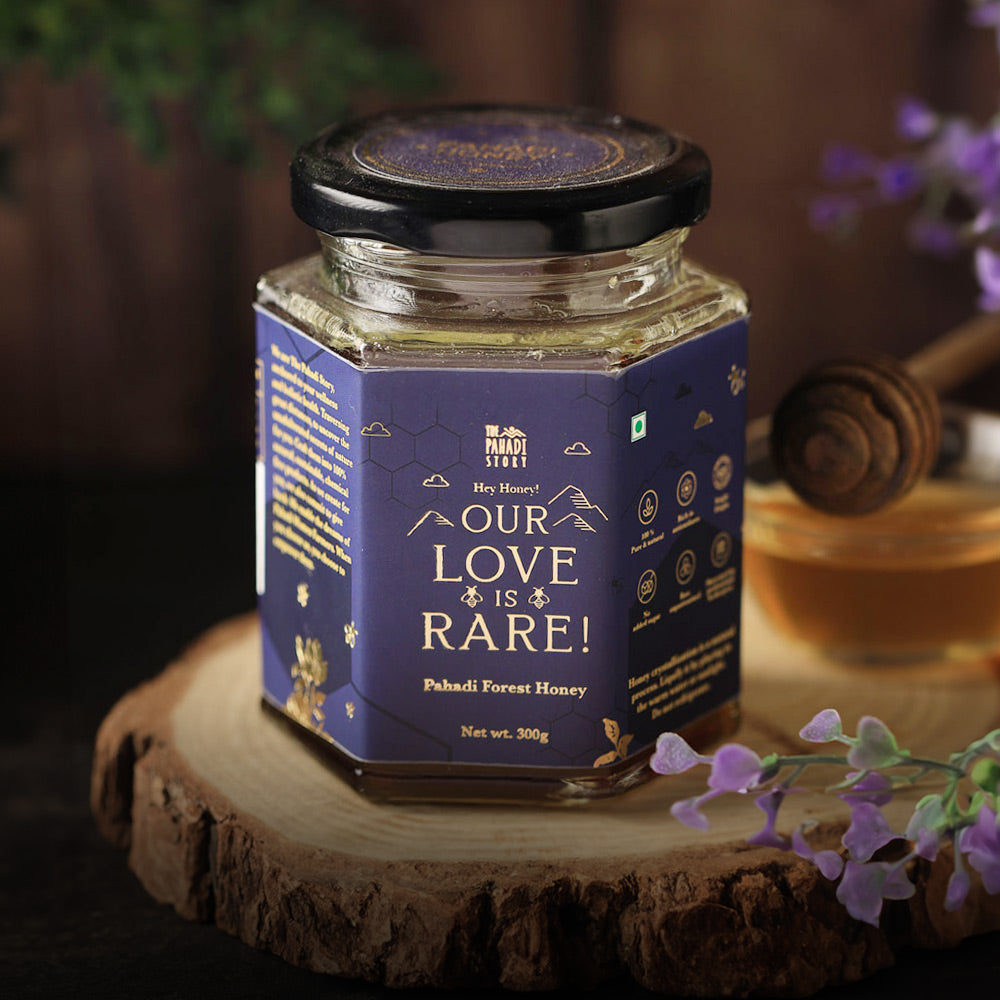
Our Rare Pahadi Forest Honey is collected from the Tarai forests of Nainital in Uttarakhand. It's raw and not pasteurised, so it keeps its natural enzymes and pollen. That also means it crystallises in winter and tastes a little different from batch to batch. Every batch is lab tested before it's packed.
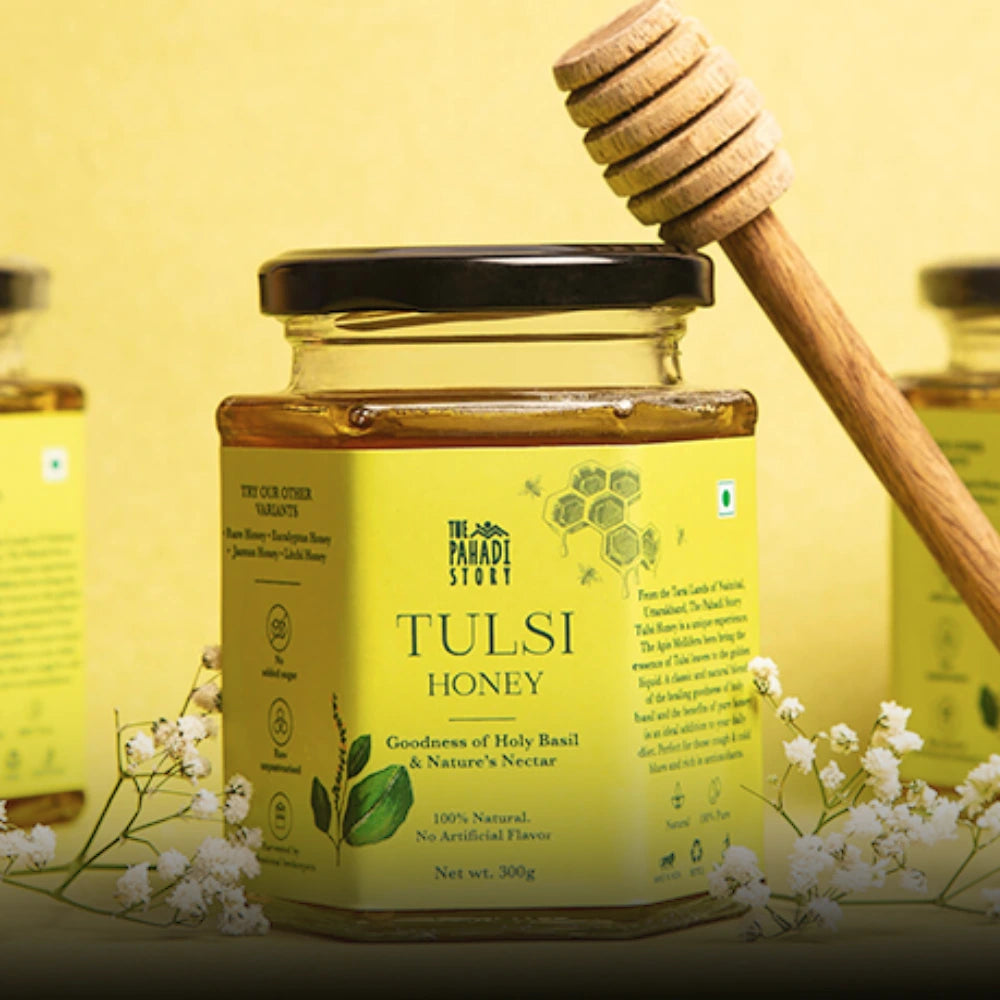
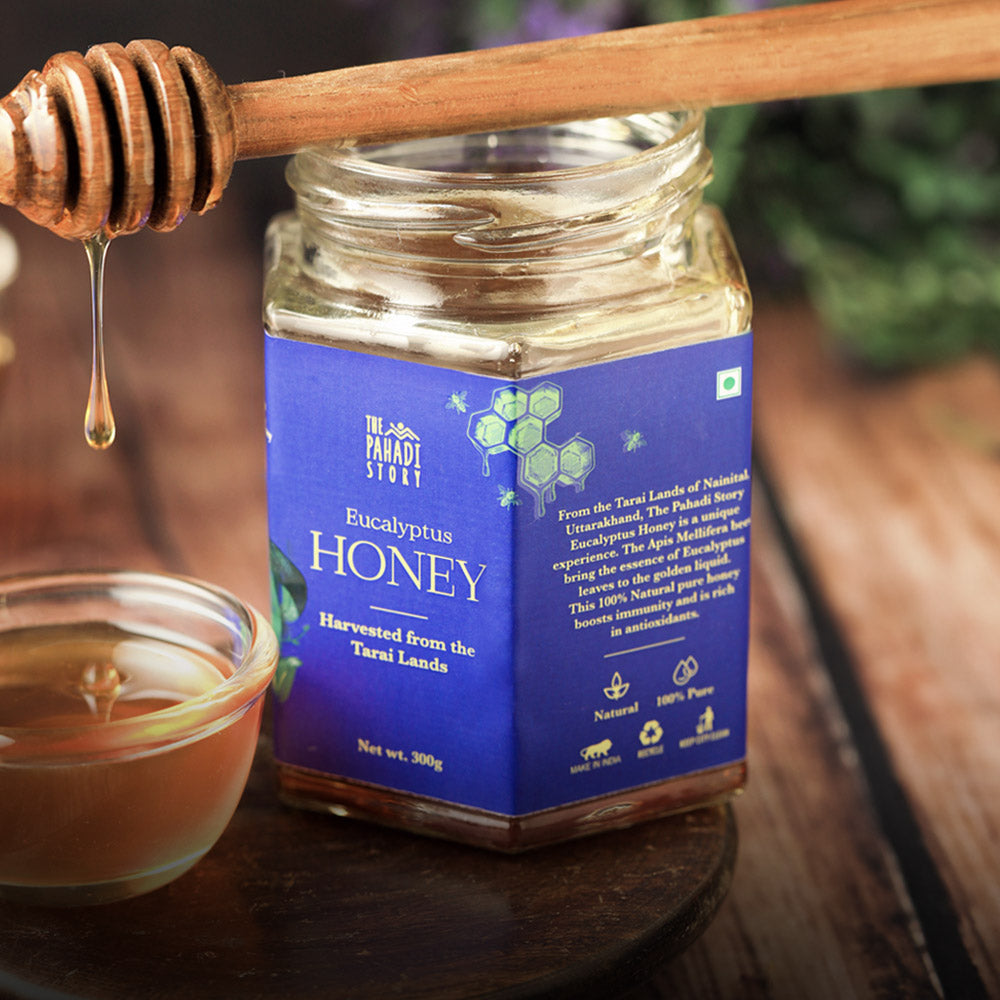
We also make Tulsi Honey and Eucalyptus Honey, each with its own taste and use.
The bottom line
Home tests are useful for catching honey with added water. They can't prove honey is pure, because today's fake honey is made to beat them. Use the water test as a quick first check, don't panic if your honey crystallises, and buy from brands that name their source and share their lab results.
Honey purity FAQs
What is the easiest way to check if honey is pure at home?
The water test. Drop a teaspoon of honey into a glass of water without stirring. Real honey sinks as a lump. Honey with added water spreads and clouds the water. It's a useful first check, but it can't prove purity.
Does pure honey dissolve in water?
Yes, eventually, when you stir it. What matters is how it behaves before stirring. Real honey sinks and holds together. Watered-down honey starts spreading straight away.
Is crystallised honey fake?
No. Crystallisation is a natural property of honey, caused by its glucose. Raw honey often crystallises faster than processed honey. Warm the jar in warm water to make it runny again.
Can fake honey pass the water and thumb tests?
Yes. Modern adulterants made from rice or corn syrup are processed to match honey's thickness, so they can sink in water and hold on your thumb just like real honey.
Which lab test is best for checking honey purity?
NMR is one of the most complete, because it compares the honey's full chemical fingerprint with real honeys. FSSAI's standard also checks C4 sugar, a rice syrup marker, foreign oligosaccharides, sucrose, moisture and more.
Does pure honey expire?
Honey stored in a sealed jar in a cool, dry place lasts a very long time. It may crystallise or darken, which is normal. If it smells sour or foams, moisture has got in and it has started to ferment.
Can I give pure honey to my baby?
Not before 12 months of age. This applies to all honey, pure or not, because it can carry spores that cause infant botulism.
Why does my honey taste different from the last jar?
Real honey changes with the flowers, the region and the season. Small differences between batches are a sign of natural honey, not a problem.