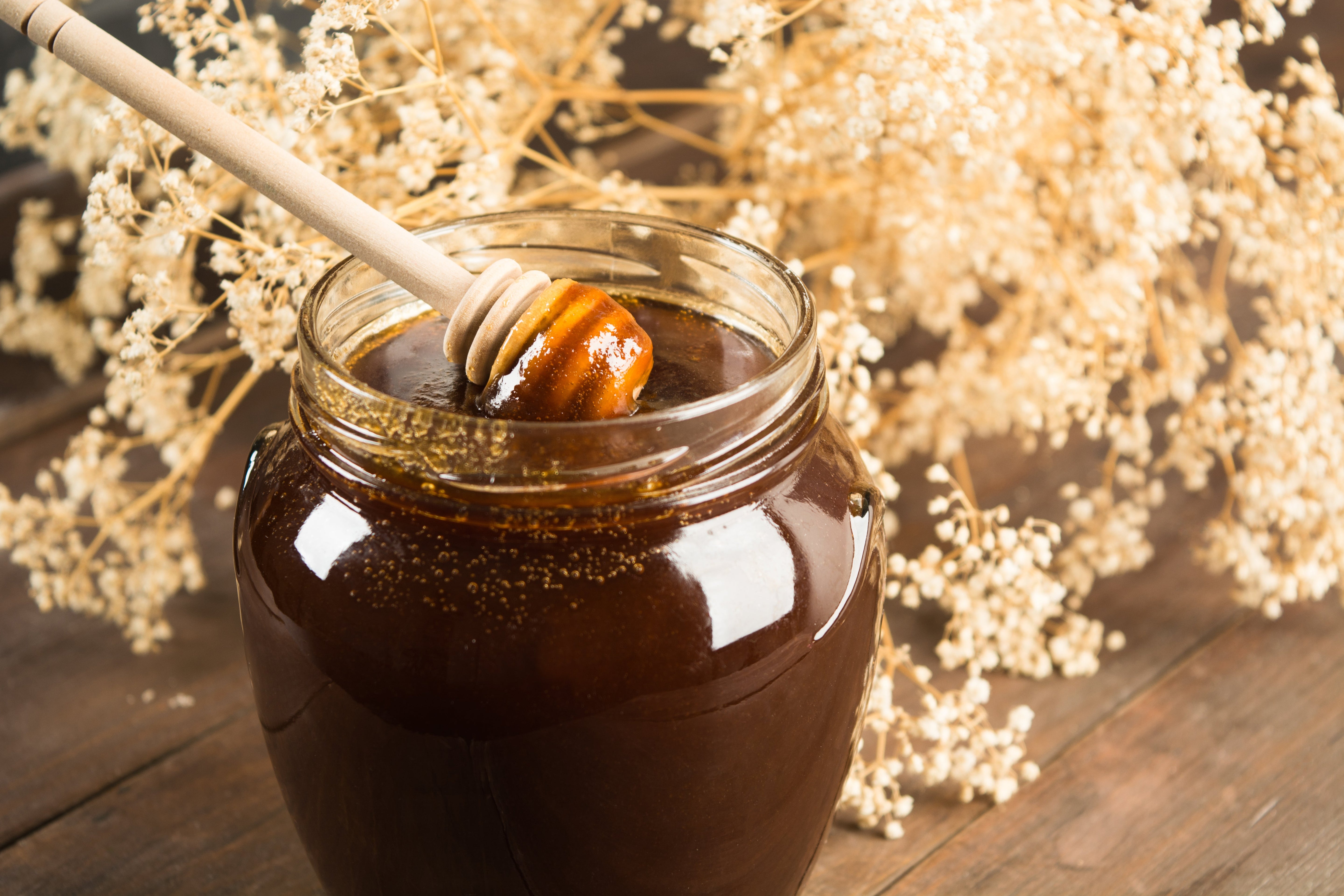



Most honey starts with a flower. A bee finds a blossom, collects the nectar, carries it home, and the hive does the rest. It is a beautiful process. It is also the only process most people know.
Honeydew honey starts somewhere else entirely.
It starts in the canopy of a forest, on the bark of a tree, in the quiet work of insects nobody notices. No flower. No nectar. Just the forest doing what forests do, and a bee paying close attention.
The result is a honey that looks different, tastes different, and tests differently from anything most Indians have ever had in their kitchen. In parts of Europe, it has been prized for centuries. In India, it has barely been named until now.
Key Takeaways
-
Honeydew honey is not made from flower nectar. Bees collect sugary secretions left by aphids and scale insects that feed on tree sap, then process it into honey the same way they process nectar.
-
It is usually darker, malty, more mineral-rich, and more complex in flavour than many blossom honeys.
-
Some of the best-known honeydew honeys come from named forest ecosystems such as fir, pine, oak, beech and chestnut forests, especially in regions where forest biodiversity is high and agricultural interference is low.
- In India, honeydew honey has not yet been widely recognised as a clear, lab-verified consumer category. The forest ecosystems may be here, but the proof-led conversation is only beginning.
-
Genuine honeydew honey carries a botanical and geographic fingerprint that only independent lab testing can confirm.
What This Blog Covers
-
What is honeydew honey and where does the name come from?
-
How is honeydew honey made? The forest process explained
-
Honeydew honey vs blossom honey at a glance
-
What does honeydew honey taste like?
-
Where in the world does honeydew honey come from?
-
What lab tests reveal about honeydew honey quality
-
Does honeydew honey exist in India?
-
How to identify genuine honeydew honey
What is Honeydew Honey and Where Does the Name Come From?
Most people who see "honeydew honey" on a label assume it has something to do with honeydew melons. It doesn't. The name refers to something else entirely, and once you understand what, honey will never look quite the same to you.
Honeydew is a sugary liquid secreted by small insects, most commonly aphids and scale insects, that feed on the sap of trees. When these insects pierce the phloem of a tree, the tissue that carries nutrients through the plant, the sap enters their system under pressure. They absorb the small amount of protein they need from it, and the rest, a concentrated, sugar-rich liquid, is expelled onto the bark, branches, leaves, and needles of the tree. That liquid is honeydew.
Bees collect this honeydew the same way they collect flower nectar, carrying it back to the hive, mixing it with their own enzymes, and processing it into honey. The result is honeydew honey: made from the forest, not the flower.
It is also known by other names including forest honey, tree honey, and fir honey or pine honey when named after its primary tree source. Many producers prefer the label "forest honey" precisely because the name honeydew creates confusion with the melon. In many parts of Europe, it is simply called forest honey because the ecosystem, not any single plant, defines what is in the jar.
One thing worth knowing: honeydew honey can be “polyfloral”, drawing from multiple tree species with no single one making up more than 10% of the total. Or it can be “monofloral”, when more than 10% of its source comes from a specific species like pine, silver fir, or beechwood. Both are genuine honeydew honey. What defines the category is the source, tree sap secretions rather than flower nectar, not the number of species involved.
How is Honeydew Honey Made? The Forest Process Explained
The production process mirrors nectar honey collection closely, but the raw material is fundamentally different.
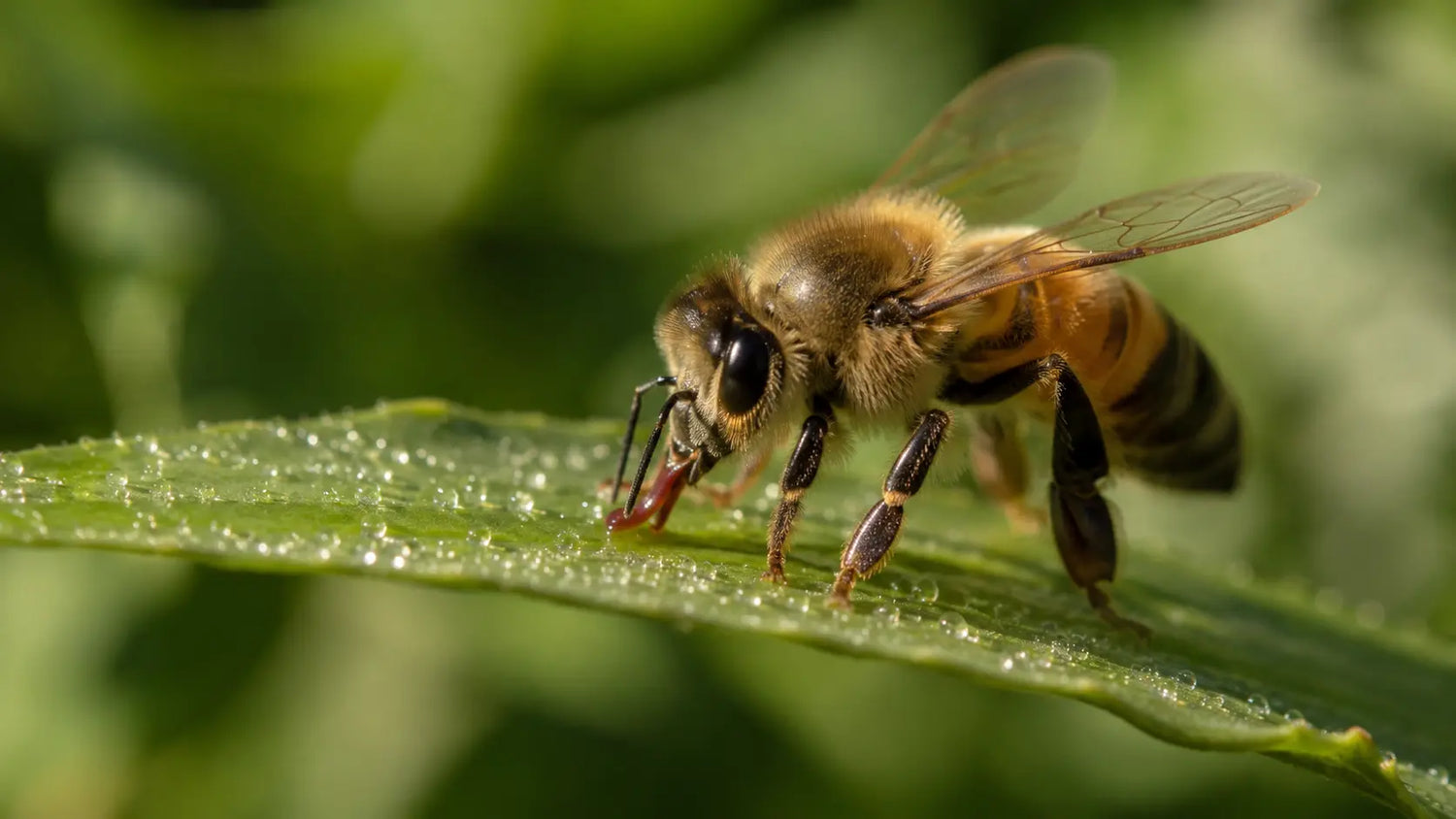
A foraging bee lands on the bark or branches of a tree where honeydew secretions have accumulated. It collects the liquid and stores it in its honey crop. Back at the hive, it transfers the honeydew to another bee, which mixes it with invertase, a bee-produced enzyme, beginning the conversion process. The bees continue passing the liquid between themselves, deepening that enzymatic conversion, before depositing it into wax cells.
They then fan the cells with their wings to reduce the water content. Once that drops below roughly 20%, the cells are capped with beeswax and the honey is complete.
What makes honeydew honey chemically distinct from blossom honey is the nature of what went in. Tree sap, and the insect secretions derived from it, carry a far broader range of plant compounds than flower nectar does. Complex phenolic acids, terpenes, minerals drawn from deep within the tree's vascular system, and oligosaccharides all make it into the finished honey. This is why honeydew honey is darker, richer in minerals, and higher in antioxidant activity than most floral honeys.
To formally qualify as honeydew honey rather than floral honey, the electrical conductivity of the finished product must measure above 0.8 milliSiemens per centimetre, as defined by the EU Honey Directive. This threshold exists precisely because honeydew honey's mineral richness is measurably higher than nectar honey. Producers who don't test for this cannot genuinely confirm what category their honey belongs to.
Honeydew Honey vs Blossom Honey at a Glance
The differences are not subtle. They run through every measurable quality marker.
|
Parameter |
Blossom Honey |
Honeydew Honey |
|
Source |
Flower nectar |
Tree sap secretions via insects |
|
Colour |
Light golden to amber |
Deep amber to near-black |
|
Sweetness |
Higher |
Lower, more complex |
|
Mineral content |
Below 0.8 mS/cm |
Above 0.8 mS/cm |
|
Antioxidant activity |
Moderate |
Significantly higher |
|
Phenolic compounds |
Lower |
Higher |
|
Oligosaccharide content |
Lower |
Higher |
|
Crystallisation |
Faster |
Slower, often resistant |
|
Flavour profile |
Floral, sweet |
Resinous, malty, mineral |
|
Common examples |
Acacia, mustard, litchi |
Fir, oak, pine, chestnut |
The darkness of honeydew honey is not cosmetic. Research has found a strong inverse relationship between colour lightness and antioxidant potency in honey. The darker the honey, the higher the phenolic content. Honeydew honeys sit at the dark end of that spectrum consistently.
What Does Honeydew Honey Taste Like?
This is where most people are surprised.
Honeydew honey does not taste like supermarket honey. It is less sweet, more layered, and has a depth that floral honeys cannot replicate. Professional tasters and organoleptic lab analysis commonly describe it as malty, resinous, and mineral, with a clean finish that lingers rather than fades.
The flavour varies depending on the dominant tree species. Fir honey from European forests is delicate and resinous. Oak honey is darker and more mineral. Pine honey is aromatic and robust.
What is consistent across all well-produced honeydew honeys is the absence of cloying sweetness. The complex sugar profile, with higher oligosaccharides and lower simple fructose than blossom honey, means the flavour evolves on the palate rather than peaking immediately and dropping off.
It works well on its own by the spoon, stirred into cooled tea, drizzled over curd, or spread on warm bread. What it is not suited to is cooking or hot liquids, where heat would undo the very enzymes that make it worth buying in the first place.
If you have only ever tasted commercial blended honey, the first spoonful of genuine honeydew honey is a re-calibration.
Where in the World Does Honeydew Honey Come From?
Europe has the most established honeydew honey tradition. Germany's Black Forest fir honey, Greek pine and oak honey, Austrian fir honey, and Swiss forest honey all have long histories and defined production standards. Greece is one of the world's largest producers of pine honeydew honey. New Zealand produces a well-recognised honeydew honey from black beech forests in its South Island, where the honey is also produced and consumed in high volumes.
The tree species that produce the highest honeydew yields include fir, pine, oak, willow, poplar, beech, plum, and peach. What connects all the world's finest honeydew honeys is altitude, biodiversity, and the absence of intensive agriculture. Forest ecosystems at elevation, with diverse tree species and minimal pesticide exposure, produce the richest honeydew secretions. That translates directly into richer, more complex, more bioactive honey.
The Himalayas and the forests of Uttarakhand, Himachal Pradesh, and the Northeast of India carry exactly these conditions. The forests are here. The tree species are here. Apis cerana, India's native Himalayan honeybee, has been foraging these forests for centuries. What has been missing is the classification, the lab testing, and the proof.
What Lab Tests Reveal About Honeydew Honey Quality
The story of honeydew honey is not just sensory. It is measurable. Here are the key lab parameters that define genuinely exceptional honeydew honey:
Diastase Activity (DZ): A bee-produced enzyme that heat destroys and time degrades. High diastase activity is proof that honey has not been heated or stored badly. The EU legal minimum for honey is 8 DZ. The German Beekeepers Association sets a premium threshold at 18 DZ. Genuinely exceptional honeydew honey scores significantly above this.
Invertase Activity (U/kg): The primary bee enzyme involved in converting raw sugars into the complex profile of finished honey. The German Beekeepers Association minimum is 64 U/kg. Higher scores indicate fresher, more enzymatically active honey.
HMF (Hydroxymethylfurfural): Forms when honey is heated or stored for long periods. A very low or undetectable HMF reading is a strong indicator that honey has not been overheated or poorly stored.
Electrical Conductivity: The formal threshold separating honeydew honey from blossom honey. Above 0.8 mS/cm confirms the mineral richness that defines the category.
NMR Profiling: Nuclear Magnetic Resonance testing gives the molecular fingerprint of honey. It can help detect authenticity markers and foreign sugar patterns that may not be fully captured by standard routine testing panels. It compares the sample against a global reference database of thousands of verified honey samples.
Pollen Analysis: Identifies the specific plant species whose pollen is present in the honey, providing geographic and botanical traceability that no other test can replicate. Pollen analysis helps support botanical and geographic traceability. Without this kind of testing, origin claims remain harder for consumers to verify.
The Bioactive Profile Worth Knowing
Beyond flavour and rarity, honeydew honey has a measurable bioactive profile that sets it apart from most honeys on the market.
Some research has studied honeydew honey for its antioxidant activity, phenolic compounds, mineral richness and antibacterial properties. These qualities are part of why honeydew honey has attracted scientific interest. This is due to honeydew honey's high content of both hydrogen peroxide and non-hydrogen peroxide antibacterial compounds, present regardless of whether the honey comes from coniferous or non-coniferous sources.
Its antioxidant activity is consistently higher than that of blossom honeys, driven by its richer phenolic and flavonoid compound content. These compounds are drawn from deep within the tree's vascular system and are simply not present in the same concentration in flower nectar.
Some studies have explored honeydew honey and other medical-grade honeys in topical wound-care contexts. However, this does not mean regular edible honey should be used as a medical treatment. Its high viscosity creates a protective barrier that maintains moist wound conditions and resists infection.
One practical note: because honeydew honey can contain pollen from a wide variety of species, those with polyfloral pollen sensitivities should exercise some caution. And as with all honey, it is not suitable for children under 12 months.
Does Honeydew Honey Exist in India?
India is one of the world’s significant honey-producing countries. It has vast forest ecosystems across the Himalayas, the Western Ghats and the Northeast. It is also home to Apis cerana, a native honeybee deeply adapted to many of these landscapes. The altitude, biodiversity, tree species and insect life found in these regions create the kind of forest conditions in which honeydew honey is known to occur globally.
And yet, for Indian consumers, honeydew honey has not been widely recognised as a clear, lab-verified category.
Not because the forests are incapable of producing it, but because the category has rarely been explained, classified or proven in a way that consumers can see and trust.
Indian honey production has largely been shaped by volume, blending and broad labels such as “forest honey” or “multiflora honey.” These terms may describe where honey comes from, but they do not automatically confirm whether a honey is genuinely honeydew honey. For that, independent testing is needed, including parameters such as electrical conductivity, pollen analysis and advanced authenticity testing.
The standard consumer understanding of honey in India still revolves around purity, sweetness and basic adulteration checks. But honeydew honey asks a more specific question: what exactly did the bees collect, and can that origin be scientifically verified?
This is where the opportunity lies. The Himalayan forests of Uttarakhand have the native bee, the altitude, the tree cover and the biodiversity that make honeydew honey possible. The next step is not just to call it forest honey, but to test it, classify it and show the evidence.
The question worth asking is this: if honeydew honey is already recognised in forest regions of Germany, Greece and New Zealand, what could independent lab testing reveal about honey from the forests of the Indian Himalayas?
How to Identify Genuine Honeydew Honey
Not everything sold as forest honey or dark honey is honeydew honey. Here is what genuine honeydew honey should have:
-
Colour: Significantly darker than typical blossom honey. Deep amber to near-black. If it is light golden, it is either misclassified or blended.
-
Electrical conductivity result: Above 0.8 mS/cm per EU Honey Directive standards. Ask the producer whether they have tested for this.
-
A named forest ecosystem: Authentic honeydew honey comes from a specific, named location. Vague claims without geographic specificity are not sufficient.
-
Independent lab verification: The best honeydew honeys in the world come with published third-party lab reports. If a producer cannot show you the test results, they cannot substantiate the classification.
-
Pollen analysis: A pollen profile with identified species is the botanical fingerprint of the honey. It tells you exactly which forest the bees visited.
Conclusion
Honeydew honey is, in many ways, the most honest expression of what a forest produces. It bypasses the flower entirely. The bees go directly to the trees, the sap, the canopy. What comes back to the hive carries the mineral signature of the forest floor, the biochemical complexity of ancient trees, and the foraging intelligence of a bee that has lived in that ecosystem for generations.
For Indian consumers, honeydew honey is still a new and unfamiliar category. Not because the forests are missing, but because the conversation has not yet been built with enough proof, testing and transparency.The Champawat hills in Kumaon just became part of a global conversation about forest honey that most of the world has been having without India for a very long time.
If you want to understand what separates a genuinely exceptional honeydew honey from an ordinary jar with a forest label on it, the next post in this series breaks down exactly that: the lab metrics that define quality, and what the numbers actually mean.
FAQs
1. What is honeydew honey in simple terms?
Honeydew honey is honey made from the sugary secretions of insects that feed on tree sap, rather than from flower nectar. Bees collect these secretions from forest trees and process them into honey the same way they process nectar. The result is darker, more mineral-rich, less sweet, and more complex in flavour than standard blossom honey.
2. Is honeydew honey better than regular honey?
Honeydew honey and blossom honey are different categories. Honeydew honey is often darker, more mineral-rich and more complex in taste. Some studies also show that honeydew honeys can have higher antioxidant and phenolic content than many blossom honeys, but quality still depends on origin, handling and testing.
3. Why is honeydew honey so dark?
Honeydew honey gets its darker colour from the tree-derived secretions and mineral-rich compounds that form its base. Darker honeys are often associated with higher phenolic content, but colour alone does not prove honeydew origin. Lab testing is still needed.
4. Does honeydew honey crystallise?
Honeydew honey is naturally resistant to crystallisation because of its complex sugar profile and lower simple glucose content compared to most blossom honeys. If it does crystallise over time, that is a natural process and a sign of genuine unprocessed honey. Gentle warming in water below 40 degrees Celsius returns it to liquid.
5. How do I know if honeydew honey is genuine?
Look for more than a label. Genuine honeydew honey should ideally have a dark colour, a clear forest origin, electrical conductivity above 0.8 mS/cm, pollen analysis and independent lab reports. Without testing, a “forest honey” claim remains difficult to verify.