


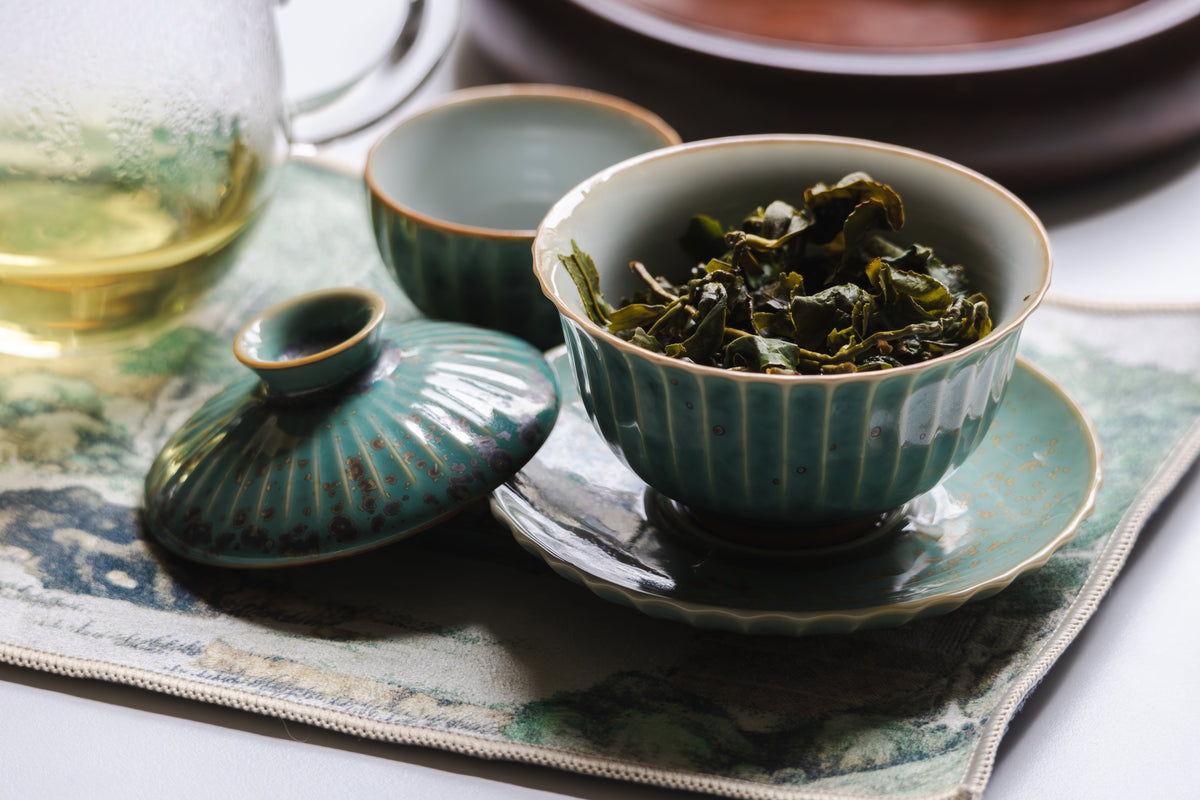
Oolong lives in the wide, in-between space of the tea world. It's more oxidised than green tea and less oxidised than black, and that one fact explains why one oolong can taste like fresh orchids while another tastes like dark chocolate and stone fruit, both fair called the same name.
This guide walks through what oolong actually is, where it comes from, how it's made, the main types and famous names you'll run into, what research does and doesn't support, and how to brew a proper cup, whether you're reaching for a teapot or trying a gaiwan for the first time.
Key Takeaways
-
Oolong tea is partially oxidised, typically somewhere between 10% and 85%, which places it between green tea (barely oxidised) and black tea (fully oxidised).
-
Oxidation level and roasting, more than the plant itself, are what give oolong its huge range of flavours. Light oolongs lean floral and buttery, dark ones lean roasted and fruity.
-
A typical 8oz cup has roughly 30 to 50mg of caffeine. That's more than green tea and less than black tea or coffee.
-
Some research links oolong tea to a short-term rise in metabolic rate, but the evidence is limited and shouldn't be read as a weight-loss promise.
-
Good oolong can be steeped many times, with the flavour shifting each round. That's part of the appeal, not a bonus feature.
What Is Oolong Tea?
Oolong tea is a partially oxidised tea made from the leaves of Camellia sinensis, the same plant behind green, black, white and pu-erh tea. What actually separates one tea type from another isn't the plant. It's how much oxidation the leaf goes through before it's heated to stop the process.
Green tea is fixed almost right away, so oxidation barely starts. Black tea is left to oxidise fully. Oolong can land anywhere in between, from around 10% to 85% oxidation depending on the choices the tea maker makes. That's what makes oolong the most varied category of tea there is. A lightly oxidised oolong can taste close to green tea, while a heavily oxidised, heavily roasted one starts moving into black tea territory.
The name comes from the Chinese wūlóng (乌龙), usually translated as "black dragon," likely a nod to the dark, twisted shape some oolong leaves take on during processing.
Where Oolong Tea Comes From
Oolong is produced mainly in China's Fujian and Guangdong provinces and across Taiwan. These aren't just growing regions, they're places where oolong is a full tea culture, and the terroir and elevation of each one shapes what ends up in the cup.
-
Anxi, Fujian is where Tie Guan Yin (Iron Goddess of Mercy) comes from. Traditionally it's medium-oxidised with a toasty, orchid-like character, though a lighter, greener modern style has become common too.
-
The Wuyi Mountains, Fujian produce yan cha, or "rock tea": heavily oxidised, charcoal-roasted oolongs known for the mineral depth locals call yan yun, "rock rhyme."
-
Phoenix Mountain, Guangdong produces Dan Cong, single-bush oolongs where each tree is prized for mimicking a specific aroma, from honey orchid to almond to ginger flower.
-
Taiwan's high mountains, places like Ali Shan, Li Shan and Da Yu Ling, grow some of the most prized light oolongs anywhere. Slower growth at altitude concentrates flavour into a creamy, floral, high-elevation cup.
How Oolong Tea Is Made
Oolong asks more of the tea maker than any other tea category, mostly because so much of the final flavour comes down to judgement calls rather than a fixed recipe.
- Plucking. Leaves are picked once the buds have opened and thickened, usually three to five at a time, since more mature leaves hold up better to everything that follows.
- Withering. Leaves are spread in the sun and then moved to shade or indoors, losing moisture and softening so they can be shaped without tearing.
- Bruising, the defining step. Leaves are tossed, shaken or lightly rolled in bamboo drums until their edges bruise. This damages the cell walls at the leaf's edge and starts oxidation from the outside in, which is where the "green centre, red edge" look on a semi-oxidised leaf comes from.
- Oxidation. Bruising and resting are repeated in rounds until the desired level is reached, judged by aroma, colour and touch rather than a timer.
- Fixing. Heat, usually from a hot wok or rotating drum, stops oxidation at the chosen point. Stop too early and the tea stays thin and grassy. Stop too late and you lose the delicate florals.
- Rolling. Leaves are shaped into tight balls, common in Taiwanese styles, or long twisted strips, common in Fujian styles. This also affects how the leaf unfurls and extracts once it's brewed.
- Roasting, which is optional. Light oolongs often skip this to keep their fresh, floral character. Traditional styles go through one or more rounds of roasting, which adds depth, sweetness and shelf life.
Types of Oolong Tea
Two dials decide where an oolong lands on the flavour spectrum: oxidation level and roast intensity.
|
Style |
Oxidation |
Roast |
Flavour |
Examples |
|
Light / green oolong |
~10 to 30% |
Little to none |
Floral, buttery, fresh |
High-mountain Taiwanese oolongs, modern Tie Guan Yin, Jin Xuan (milk oolong) |
|
Medium oolong |
~30 to 60% |
Light to medium |
Toasty, nutty, caramel |
Dong Ding, traditional Tie Guan Yin |
|
Dark / heavy oolong |
~60 to 85% |
Medium to heavy |
Roasted, mineral, stone fruit |
Da Hong Pao, Rou Gui, heavily oxidised Oriental Beauty |
As a general rule, lighter oolongs are more delicate and do better with slightly cooler water, while darker, more roasted ones can take hotter water and longer steeps without turning bitter.
Famous Oolong Teas Worth Knowing
-
Tie Guan Yin (Iron Goddess of Mercy): Anxi, Fujian's most famous oolong, named after the Buddhist bodhisattva Guanyin. Floral and orchid-like when lightly oxidised, deeper and more caramel-forward in its traditional, more roasted form.
-
Da Hong Pao (Big Red Robe): the best-known Wuyi rock oolong, valued for its roasted depth, mineral character and long "rock rhyme" aftertaste.
-
Dan Cong: single-bush oolongs from Phoenix Mountain, each one named for the specific fragrance it's known to mimic.
-
Jin Xuan (Milk Oolong): a Taiwanese cultivar known for a naturally creamy, milk-like character, no added flavouring needed when it's made well.
-
Oriental Beauty (Bai Hao): a heavily oxidised Taiwanese oolong whose honeyed, fruity character actually comes from leafhopper bites, which trigger a natural chemical response in the leaf.
What Does Oolong Tea Taste Like?
Because oolong covers such a wide oxidation range, there isn't one answer to what it tastes like.
-
Light oolongs taste fresh and floral, think orchid or lily, sometimes with a buttery, creamy body, and little to no bitterness when brewed well.
-
Medium oolongs move toward toasted grain, caramel and a touch of stone fruit, with more body than the light styles.
-
Dark oolongs bring roasted depth, mineral notes and dried or stone fruit sweetness. They edge closer to black tea but are usually smoother, with less of the tannic bite.
A good oolong also tends to change as you steep it more than once. The first infusion is often bright and immediate, the middle ones show the tea at its fullest, and the later steeps turn soft and sweet.
Oolong Tea vs Green Tea vs Black Tea
|
Green Tea |
Oolong Tea |
Black Tea |
|
|
Oxidation |
Minimal |
Partial (10 to 85%) |
Full |
|
Typical flavour |
Grassy, vegetal, light |
Floral to roasted, wide range |
Malty, bold, robust |
|
Typical caffeine (8oz cup) |
~20 to 45mg |
~30 to 50mg |
~40 to 70mg |
|
Re-steeping |
2 to 3 infusions |
5 to 10+ infusions |
1 to 2 infusions |
|
Best water temp |
Lower (75 to 85°C) |
Varies by style (85 to 100°C) |
Higher (95 to 100°C) |
Oolong Tea and Caffeine
Yes, oolong tea has caffeine. It comes from the same plant as green and black tea, so that's expected. According to USDA FoodData Central, an average 8oz (240ml) cup has roughly 37mg, though independent tests of different oolongs have found a much wider range, anywhere from about 16mg to 55mg per cup, depending on the variety, leaf grade, water temperature and how long it's steeped. A rough rule of thumb: lighter, shorter-steeped oolongs sit closer to green tea's caffeine level, and darker, longer-steeped ones sit closer to black tea's.
If you're sensitive to caffeine, a shorter steep or a lighter oolong style will naturally keep the cup gentler.
What the Research Actually Says
Oolong tea sometimes gets marketed hard around weight loss and metabolism, so it's worth being precise about what's actually been studied, because the evidence is thinner than the marketing suggests.
Human evidence. A small study of adult men, published in The Journal of Nutrition (Rumpler et al., 2001), found that drinking oolong tea was linked to a temporary rise in energy expenditure and fat oxidation compared with water. It's a real, peer-reviewed finding, but it's a small study in one population, and a short-term metabolic change isn't the same as proven, lasting weight loss. No credible study has shown that oolong tea causes weight loss on its own.
Preclinical evidence. A few animal studies, mostly in rats and mice on high-fat diets, have found that oolong tea extracts were associated with lower body fat and better markers like cholesterol and blood sugar in those animals. That's useful mechanistic evidence, but findings from animal studies don't automatically carry over to people, and none of it should be read as a health claim about drinking the tea yourself.
The honest summary. Oolong tea may be linked to a modest, short-term rise in metabolic rate, and its polyphenols are being studied for other effects too, but the current evidence doesn't support treating oolong as a weight-loss or medical intervention. If you're managing a health condition, especially one involving weight, blood sugar or caffeine sensitivity, it's worth talking to a doctor or dietitian rather than relying on tea alone.
How to Brew Oolong Tea
Oolong does better with a heavier hand and shorter steeps than one long infusion. That's what lets you pull several distinct cups out of the same leaves.
Gongfu brewing (recommended for quality oolong)
- Use a gaiwan or a small clay teapot, around 100 to 150ml.
- Add 5 to 7g of leaf, about a third of the vessel if you're using ball-rolled oolong.
- Rinse briefly with hot water and pour it off. This "wakes" the leaves.
- Steep for 15 to 20 seconds on the first infusion, pouring off completely each time.
- Add roughly 5 to 10 seconds to the steep time each round. Ball-rolled oolongs often need two or three infusions just to fully unfurl, so don't judge the tea on the first cup.
- Keep going for 5 to 10 infusions or more, until the flavour finally fades.
Western-style brewing (simpler, fewer infusions)
- Use 2 to 3g of leaf per 200ml of water.
- Steep for 3 to 5 minutes.
- You'll typically get 2 to 3 good infusions this way.
On temperature: light, floral oolongs generally do better around 85 to 90°C, while darker, roasted oolongs can handle 90 to 100°C without turning bitter.
How to Store Oolong Tea
-
Light, unroasted oolongs are the most delicate of the bunch. Store them airtight, cool and dark, and try to use them within 6 to 12 months for the best flavour.
-
Roasted or darker oolongs are far more forgiving and can hold well for one to three years. Some are even meant to be aged.
-
Either way, keep oolong away from moisture, direct light and strong smells. Tea picks up odours easily.
How to Choose Good Oolong Tea
Start with the leaf itself, colour, shape and consistency should look even, not dusty or broken. Smell the dry leaf, then brew and taste it before you go looking into the backstory. A good tea should hold up on its own before its origin story does the convincing for it.
Provenance tends to matter more with oolong than with most teas, simply because the process is so hands-on. A single-origin oolong with a named cultivar and growing region is usually a safer bet than a generic "oolong tea" with no sourcing details at all.
Frequently Asked Questions
Is oolong tea good for weight loss?
Not on its own. A small human study found a short-term rise in metabolic rate after drinking oolong tea, and a few animal studies suggest a possible effect on fat metabolism, but there's no solid evidence that oolong tea causes weight loss by itself.
How many times can you steep oolong tea?
Good oolong, brewed gongfu-style, can usually be steeped 5 to 10 times or more, with the flavour changing each round. Western-style brewing typically gives you 2 to 3 good infusions.
Does oolong tea have caffeine?
Yes. A typical 8oz cup has roughly 30 to 50mg, more than green tea and less than black tea or coffee, though this shifts depending on the oolong style and how long it's brewed.
Is oolong tea the same as green tea?
No. They come from the same plant, but green tea is essentially unoxidised while oolong is partially oxidised, anywhere from about 10% to 85% depending on the style.
Is oolong tea good for beginners?
Light, floral oolongs, like a high-mountain Taiwanese oolong or a milk oolong, tend to be the easiest place to start, since they're smooth and fairly forgiving of small brewing mistakes.
Sources & References
-
USDA FoodData Central: caffeine content, tea, oolong (average and range)
-
Rumpler, W. et al. "Oolong Tea Increases Metabolic Rate and Fat Oxidation in Men." The Journal of Nutrition, 2001. (PubMed ID: 11694607)
-
Preclinical findings on oolong tea and lipid metabolism, published in peer-reviewed nutrition journals (animal studies, not evidence of human outcomes)
This article is for general educational purposes and does not replace personalised advice from a qualified healthcare professional.